I am about to confess. I’m becoming aware I’m a passive viewer which in these days it doesn’t seem a good thing. I could use an euphemism and say I’m a classic viewer, though, since I seek stability, beauty and calmness. I like to stand in front of the work of art, take my time and enjoy looking at it. Yes, perhaps, move a bit to the front, step back, give one step aside, give another one in the opposite direction, and maybe sit in the bench in front of it. However, that’s it or at least I think it is. I don’t like to be pushed to do something, I don’t feel comfortable to be imposed expectations to fulfill and I don’t enjoy being physically destabilized.
Therefore, the simple act of trying to make sense of the notions of engagement and participation and to relate them with my own experience destabilizes me, which I believe, is a good thing because what it is clear to me, along with the awareness of what kind of viewer I think I am, is I do enjoy being intellectually destabilize. I firmly believe that only when your certainties are challenged is when you start to really get to know yourself and everything around you.
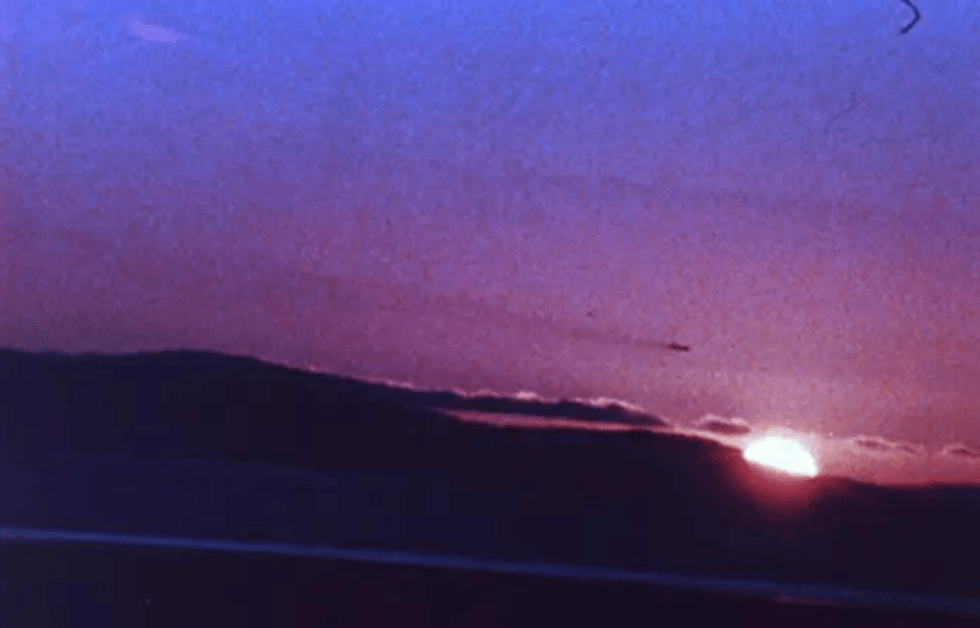
So, I may not feel naturally attracted to certain contemporary works of art, but I found in John Cage, 4’33, 1952 and Andy Warhol’s, Sunset, 1967, the kind of destabilizing experience I really feel related to.
Sunset is a film, lasting thirty-three minutes, of one single static shot of a sunset in real time. The work was commissioned by art patrons John and Dominique de Menil for a Vatican pavilion for Hemisfair ’68, a fair world held in San Antonio, Texas in 1968. Nonetheless, the pavilion never came to materialization and the project was left unfinished and unseen until 2000, when itwas restored and re-released as part of The Andy Warhol Film Project. Right now, is being shown in McNay Art Museum in the same city it was supposed to be exhibited in the first place, San Antonio, Texas.
The film is shown in an unlit gallery room with lines of benches, some sort of very austere improvised cinema theatre. You can join the show at any time. There is an entrance to the room but no proper door. In a wall, outside the film exhibit room, there is a clock showing a countdown. It is showing the remaining minutes of the film before It starts over, again and again.
What is expected from the audience is to watch the spectacle of the sun fading through the thirty-three whole minutes, while listening to rock band Velvet Underground vocalist, Nico, reciting a poem off-record. I don’t know if it’s deliberated but the sound is faulty, it gives the impression of being recorded non-professionally. Nico’s voice can hardly be heard, it gets lost in the distance and the white noise, therefore, the words and the sense of the poem can’t be grasp. Actually, it provokes anxiety because even though you’re fully present and disposed to understand, you can’t. I guess that in some way it can be found beautiful because it resembles an unintelligible ritual chant coming from somewhere deep beyond.
The experience becomes unsettling from the very beginning when the viewer is watching an image of the sun in the horizon barely moving. The minutes run and the moving image seems static. Even though, the sun is disappearing in real time the feeling is you’re watching a slow-motion scene. If the experience was supposed to be disquieting for the sixties viewer for the current audience I’m inclined to believe is almost unbearable. -For me it was-. The act of waiting and experience the elongation of time might become exasperating in the same way Cage’s 4’33.
Watching Sunset and taking part in 4’33 becomes destabilizing in ways I found similar. In both you enter a performance site, a very similar setting in which you enter and sit expecting to be amused and/or entertained. When you enter a fictional space you sign an implicit contract with the artist/writer in which is stated that you, as a spectator/reader you’re a going to believe whatever story is narrated to you as long as it is well-narrated, meaning, as long as it follows certain rules -verisimilitude within the fictional universe is one of those rules-. The implicit contract establishes too the viewer is willing to engage in the make-believe play. All works of art are make-believe plays.
Nevertheless, Warhol and Cage broke the implicit contract with the viewer and both are establishing a new set of rules which stand like this: 1. The former rules no longer apply. 2. I, the artist/author, am not longer obliged to entertain you to expect your undivided attention. 3. If you are expecting to get something from this artwork you have to play by my rules which, in this particular case, are that you have to be patient and learn to wait.
In tandem, there is a reflection about time and space, in how do we fill both of them, and how aware we consciously are about inhabiting both. Cage explores the notions of emptiness and silence not only outwardly but inwardly. The apparent silence and emptiness of the concert hall put in the forefront by 4’33 face the viewers with themselves in the same way Sunset does. Your cornered, you can’t escape -you can of course but you signed the implicit contract- and what is left is you with yourself, with your thoughts, your uncomfortable emotions, the controlled or uncontrolled reactions that are arising within you, briefly, the awareness of your own oneself.
What does silence allow to emerge to the surface? What does immobility and stillness? There is no coincidence, Cage practiced Buddhism Zen and Warhol was Catholic and profoundly religious. -Browse in the internet “Andy Warhol spirituality”, you’ll get surprised-. Moreover, Sunset was commissioned to Warhol by the Menils with a very specific purpose, create a work of art with spiritual significance.
What are the basic principles of meditation, to sit, close your eyes and repeat a mantra. Prayer requires the same routine. Those three apparently innocuous actions lead the participant to achieve one apparently simple but deeply complex aim, to still the mind. Your undivided attention in something outwards allows you to go inwards.
Therefore, 4’33 and Sunset function -from my point of view, of course- as metaphors of the practice of meditation and prayer itself. They depict tangible forms to express what is experienced by the mind when you sit in stillness to deliberately empty your mind to connect with your inner and higher self.
At first, when you sit and close your eyes and start watching your thoughts the mind becomes a screen exhibiting the flow of your thoughts. When you’re not use to this you feel very, very anxious and you want to stand up and leave. However, if you, paradoxically, don’t engage with your thoughts or emotions, meaning you don’t react to them and, leave them merge where they came from and, instead, focus in repeating the mantra or your prayer, your mind starts to settle, and then you can experience the sweetness of emptiness, silence and the sun of your mind disappearing inside you.
© Ana Márquez, 2023.
 Ana Márquez